

Evidence-Based Herbal Medicine: Bridging Traditional Knowledge with Scientific Validation
Evidence-Based Herbal Medicine: Bridging Traditional Knowledge with Scientific Validation
Introduction
Traditional medicine systems have served humanity for thousands of years, providing therapeutic solutions for a wide range of diseases and health conditions. Across Asia, Africa, Europe, and the Americas, medicinal plants have formed the foundation of healthcare practices long before the emergence of modern pharmaceuticals.
Today, the global healthcare community is witnessing a renewed interest in herbal medicine. The growing demand for natural therapies, increasing prevalence of chronic diseases, rising healthcare costs, and concerns regarding adverse drug reactions have encouraged both researchers and healthcare professionals to revisit traditional medicinal knowledge.
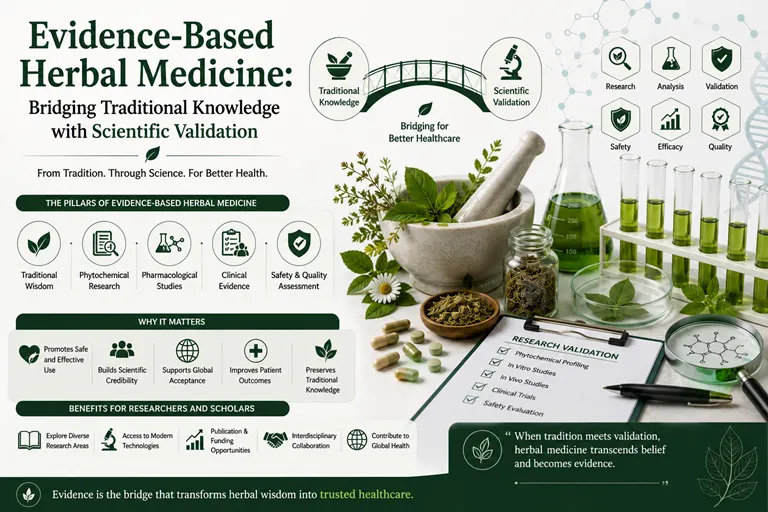
However, modern healthcare systems increasingly demand scientific evidence regarding the safety, efficacy, quality, and mechanisms of herbal medicines. This requirement has given rise to the concept of evidence-based herbal medicine, an approach that seeks to integrate centuries of traditional knowledge with rigorous scientific validation.
The International Journal of Pharmacognosy and Herbal Drug Technology (IJPHDT) recognizes the importance of this integration and encourages research that bridges traditional medicine and modern pharmaceutical sciences.
What Is Evidence-Based Herbal Medicine?
Evidence-based herbal medicine refers to the use of herbal products and traditional medicinal practices that are supported by scientific research and validated through systematic investigation.
This approach combines three essential components:
- Traditional knowledge and clinical experience
- Scientific evidence and experimental research
- Professional healthcare decision-making
The goal is not to replace traditional medicine but to strengthen its scientific foundations and improve its acceptance within modern healthcare systems.
The Rich Legacy of Traditional Herbal Medicine
Traditional medicinal systems such as:
- Ayurveda
- Traditional Chinese Medicine
- Unani Medicine
- Siddha Medicine
- Indigenous and folk medicine systems
have accumulated extensive knowledge regarding the therapeutic use of medicinal plants.
This traditional knowledge includes:
- Plant selection
- Preparation methods
- Dosage recommendations
- Therapeutic indications
- Safety observations
Many modern medicines have originated directly or indirectly from traditional medicinal practices.
The challenge for contemporary researchers is to scientifically validate these traditional claims and translate them into evidence-based healthcare solutions.
Why Scientific Validation Matters
Improving Patient Safety
Scientific studies help identify:
- Toxic compounds
- Drug interactions
- Contraindications
- Safe dosage ranges
Safety assessment is essential for protecting patients and improving confidence in herbal therapies.
Demonstrating Therapeutic Efficacy
Many traditional remedies possess therapeutic potential, but modern healthcare requires objective evidence.
Scientific validation provides:
- Pharmacological data
- Clinical evidence
- Mechanistic understanding
- Comparative effectiveness studies
Enhancing Global Acceptance
Evidence-based research helps herbal medicines gain recognition among:
- Physicians
- Pharmacists
- Regulatory authorities
- Healthcare organizations
- Academic institutions
Supporting Regulatory Approvals
Regulatory agencies increasingly require scientific documentation regarding:
- Quality
- Safety
- Efficacy
- Manufacturing standards
Scientific evidence is therefore essential for the broader integration of herbal medicine into healthcare systems.
The Role of Pharmacognosy in Evidence-Based Herbal Medicine
Pharmacognosy serves as the scientific bridge between traditional knowledge and modern medicine.
The discipline contributes through:
- Plant authentication
- Phytochemical investigations
- Standardization studies
- Pharmacological evaluations
- Toxicological assessments
- Herbal formulation development
Pharmacognosy transforms traditional observations into scientifically validated therapeutic knowledge.
Scientific Approaches for Herbal Medicine Validation
Ethnopharmacological Studies
Ethnopharmacology investigates the traditional use of medicinal plants and documents indigenous therapeutic practices.
Research opportunities include:
- Community-based studies
- Documentation of traditional knowledge
- Comparative ethnobotanical investigations
- Preservation of medicinal heritage
Ethnopharmacological research often provides the foundation for modern drug discovery.
Phytochemical Investigations
Scientific validation begins with understanding plant chemistry.
Researchers investigate:
- Alkaloids
- Flavonoids
- Phenolic compounds
- Terpenoids
- Glycosides
- Bioactive metabolites
Modern analytical techniques include:
- HPLC
- GC-MS
- LC-MS
- NMR spectroscopy
- Metabolomics
Phytochemical profiling helps identify compounds responsible for therapeutic activities.
Pharmacological Studies
Pharmacological investigations evaluate:
- Anti-inflammatory activity
- Antimicrobial effects
- Anticancer potential
- Antidiabetic properties
- Antioxidant effects
- Neuroprotective activities
These studies provide experimental evidence supporting traditional claims.
Toxicological Evaluation
Not all natural products are inherently safe.
Scientific evaluation is necessary to determine:
- Acute toxicity
- Chronic toxicity
- Genotoxicity
- Reproductive toxicity
- Drug interactions
Safety assessments are fundamental components of evidence-based herbal medicine.
Clinical Research and Human Studies
Clinical investigations provide the highest level of scientific evidence.
Research methodologies include:
- Observational studies
- Randomized controlled trials
- Comparative studies
- Systematic reviews
- Meta-analyses
Clinical evidence plays a crucial role in integrating herbal medicine into mainstream healthcare.
Herbal Drug Standardization and Quality Assurance
One of the biggest challenges in herbal medicine is product variability.
Scientific standardization involves:
- Authentication of medicinal plants
- Marker compound identification
- Quality control parameters
- Chromatographic fingerprinting
- Batch consistency evaluation
Standardized products improve reproducibility and strengthen scientific credibility.
Challenges in Evidence-Based Herbal Medicine
Despite significant progress, several challenges remain.
Complex Chemical Composition
Medicinal plants contain numerous bioactive compounds that may act synergistically.
Lack of Standardization
Variability in raw materials often complicates scientific investigations.
Limited Clinical Evidence
Many traditional therapies still require well-designed clinical studies.
Funding Limitations
Large-scale herbal medicine research frequently faces financial constraints.
Preservation of Traditional Knowledge
Indigenous knowledge systems are increasingly threatened by cultural and environmental changes.
The Growing Role of Artificial Intelligence and Modern Technologies
Modern technologies are transforming herbal medicine research.
Artificial Intelligence
Applications include:
- Drug-target prediction
- Virtual screening
- Data mining
- Pattern recognition
- Compound activity prediction
Metabolomics
Metabolomics allows:
- Comprehensive phytochemical profiling
- Biomarker identification
- Quality control studies
Systems Biology
Integrated approaches combine:
- Genomics
- Proteomics
- Metabolomics
- Bioinformatics
These technologies are accelerating the scientific validation of traditional medicines.
Evidence-Based Herbal Medicine in Chronic Disease Management
Herbal medicines are increasingly investigated for:
- Diabetes
- Obesity
- Cardiovascular diseases
- Cancer
- Neurological disorders
- Inflammatory diseases
- Liver disorders
Natural products continue to provide promising therapeutic opportunities for complex diseases that often require multi-target approaches.
Research Opportunities for Scholars in 2026
The future of evidence-based herbal medicine offers enormous opportunities for researchers.
Emerging areas include:
- Herbal clinical research
- Precision herbal medicine
- AI-assisted pharmacognosy
- Herbal metabolomics
- Multi-omics investigations
- Herbal pharmacovigilance
- Standardization studies
- Ethnopharmacological validation
- Integrative medicine research
- Natural product drug discovery
Interdisciplinary collaboration will become increasingly important in these areas.
Publication Opportunities in Evidence-Based Herbal Medicine
Research in evidence-based herbal medicine contributes significantly to:
- Public health
- Pharmaceutical innovation
- Integrative healthcare
- Drug discovery
- Scientific validation of traditional medicine
The International Journal of Pharmacognosy and Herbal Drug Technology (IJPHDT) welcomes manuscripts involving:
- Ethnopharmacology
- Medicinal plant research
- Clinical investigations
- Herbal drug standardization
- Pharmacological evaluations
- Natural product chemistry
- Evidence-based healthcare studies
- Integrative medicine research
The journal aims to provide an international platform for research that bridges traditional medicinal knowledge and modern scientific methodologies.
Digital Publishing and Research Visibility
High-quality research deserves efficient dissemination and global discoverability.
Modern publishing technologies facilitate:
- Faster manuscript processing
- DOI integration
- Improved metadata management
- Better indexing readiness
- Enhanced author experience
Platforms such as ScholarJMS help journals streamline editorial workflows and manuscript management, while GetDOI supports journals with Crossref DOI implementation and metadata management.
A Soft Note for Journal Editors and Publishers
The increasing interest in herbal medicine research has encouraged many institutions and scholarly societies to establish specialized journals in pharmacognosy and medicinal plant sciences.
Professional services such as OJSCloud support journals through:
- Journal website development
- ISSN consulting
- OJS hosting and migration
- Publishing workflow implementation
- Journal launch consulting
These services help journals establish sustainable and professionally managed publishing ecosystems.
Frequently Asked Questions
What is evidence-based herbal medicine?
It is the integration of traditional medicinal knowledge with scientific evidence regarding safety, efficacy, and quality.
Why is scientific validation important in herbal medicine?
Scientific validation improves safety, supports clinical acceptance, and strengthens confidence in herbal therapies.
Can traditional knowledge contribute to modern drug discovery?
Yes. Many modern medicines have originated from traditional medicinal practices and natural products.
What role does pharmacognosy play in evidence-based medicine?
Pharmacognosy provides scientific methods for authentication, phytochemical analysis, standardization, and pharmacological evaluation.
Where can researchers publish studies in evidence-based herbal medicine?
Researchers can publish their findings in specialized journals such as the International Journal of Pharmacognosy and Herbal Drug Technology and other peer-reviewed journals focusing on medicinal plants and pharmaceutical sciences.
Conclusion
Evidence-based herbal medicine represents the successful integration of ancient therapeutic wisdom and modern scientific inquiry.
By combining traditional knowledge with rigorous pharmacological, phytochemical, clinical, and technological investigations, researchers can strengthen the credibility of herbal medicine and contribute to the development of safer and more effective healthcare solutions.
The future of pharmacognosy lies not in choosing between traditional medicine and modern science, but in building meaningful bridges between the two.
The International Journal of Pharmacognosy and Herbal Drug Technology (IJPHDT) remains committed to supporting innovative research that advances evidence-based herbal medicine and encourages scholars worldwide to contribute to this rapidly evolving scientific field.