

Herbal Drug Standardization: Why Quality Control Matters in Pharmacognosy Research
Herbal Drug Standardization: Why Quality Control Matters in Pharmacognosy Research
Introduction
The global market for herbal medicines and natural health products has experienced remarkable growth during the past two decades. Medicinal plants and herbal formulations are increasingly being used in preventive healthcare, chronic disease management, nutraceutical development, and integrative medicine. Despite this growing acceptance, one of the most significant challenges facing herbal medicine research remains the issue of quality, consistency, and reproducibility.
Unlike synthetic drugs, herbal medicines are complex mixtures containing numerous bioactive compounds whose composition may vary considerably depending on geographical location, cultivation practices, harvesting conditions, processing methods, and storage environments.
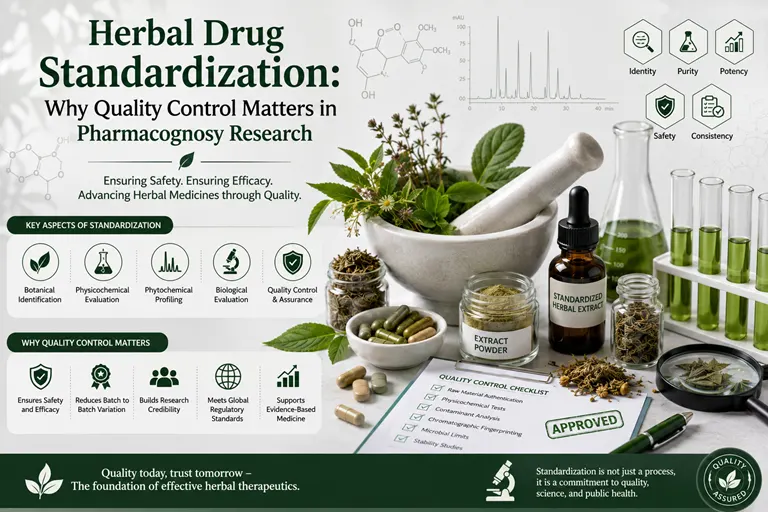
These variations make herbal drug standardization one of the most critical areas of research in pharmacognosy and herbal drug technology.
Without proper standardization and quality control, it becomes difficult to ensure:
- Safety
- Therapeutic efficacy
- Batch-to-batch consistency
- Regulatory compliance
- Scientific reproducibility
- International acceptance of herbal medicines
The International Journal of Pharmacognosy and Herbal Drug Technology (IJPHDT) recognizes herbal drug standardization as a fundamental pillar of evidence-based herbal medicine and encourages researchers worldwide to contribute innovative studies that strengthen the quality and credibility of medicinal plant research.
Understanding Herbal Drug Standardization
Herbal drug standardization refers to the establishment of defined quality parameters that ensure the identity, purity, safety, and efficacy of medicinal plants and herbal formulations.
The process involves:
- Authentication of plant materials
- Identification of active constituents
- Determination of quality markers
- Detection of adulterants and contaminants
- Establishment of physicochemical standards
- Validation of analytical methods
The ultimate goal of standardization is to guarantee that every batch of herbal medicine consistently meets predetermined quality specifications.
Why Quality Control Is Essential in Herbal Medicine
Ensuring Patient Safety
Poor-quality herbal products may contain:
- Toxic compounds
- Heavy metals
- Pesticide residues
- Microbial contaminants
- Adulterants
- Misidentified plant materials
Such contaminants can lead to adverse effects and undermine public confidence in herbal medicine.
Maintaining Therapeutic Efficacy
Variations in phytochemical composition can significantly alter the effectiveness of herbal products.
Standardization ensures that herbal medicines contain:
- Appropriate concentrations of active compounds
- Consistent therapeutic properties
- Reliable pharmacological effects
Supporting Scientific Reproducibility
Scientific studies require reproducible materials.
Without quality control:
- Research findings become inconsistent.
- Clinical outcomes become difficult to interpret.
- Comparative studies become unreliable.
Standardized herbal materials improve the reliability and credibility of pharmacognosy research.
Meeting Regulatory Requirements
Regulatory authorities increasingly require scientific evidence demonstrating:
- Product quality
- Safety
- Manufacturing consistency
- Analytical validation
Standardization is therefore essential for both academic research and commercial product development.
Sources of Variability in Medicinal Plants
One of the biggest challenges in pharmacognosy is the natural variability of medicinal plants.
Environmental Factors
Plant composition may vary due to:
- Climate
- Soil composition
- Rainfall
- Altitude
- Seasonal changes
Genetic Factors
Different species, subspecies, and chemotypes may exhibit substantial differences in phytochemical composition.
Agricultural Practices
Variations in:
- Cultivation methods
- Fertilizer use
- Irrigation practices
- Harvesting techniques
can affect the quality of medicinal plants.
Post-Harvest Processing
Improper:
- Drying
- Storage
- Transportation
- Extraction procedures
can result in degradation of active constituents.
Major Components of Herbal Drug Standardization
Botanical Authentication
Correct identification of medicinal plants is the first step in quality assurance.
Authentication methods include:
- Macroscopic examination
- Microscopic analysis
- Taxonomic identification
- DNA barcoding
Plant misidentification remains a major cause of herbal product quality problems worldwide.
Organoleptic Evaluation
Organoleptic studies examine:
- Colour
- Taste
- Odour
- Texture
- Morphological characteristics
These evaluations provide preliminary information regarding plant identity and quality.
Physicochemical Parameters
Quality assessment often includes:
- Moisture content
- Ash values
- Extractive values
- Foreign matter determination
- Swelling index
- Foaming index
These parameters help establish official quality specifications.
Phytochemical Screening
Phytochemical investigations identify the presence of:
- Alkaloids
- Flavonoids
- Tannins
- Glycosides
- Terpenoids
- Phenolic compounds
- Saponins
These studies provide important information regarding therapeutic potential.
Chromatographic Fingerprinting
Modern standardization relies heavily on chromatographic techniques such as:
- High Performance Liquid Chromatography (HPLC)
- Thin Layer Chromatography (TLC)
- High Performance Thin Layer Chromatography (HPTLC)
- Gas Chromatography Mass Spectrometry (GC-MS)
- Liquid Chromatography Mass Spectrometry (LC-MS)
These methods allow:
- Identification of marker compounds
- Detection of adulterants
- Batch consistency evaluation
- Quantitative analysis
Microbiological and Toxicological Evaluation
Microbial Contamination
Herbal materials can become contaminated with:
- Bacteria
- Fungi
- Yeasts
- Pathogenic microorganisms
Microbiological testing is therefore essential.
Heavy Metal Analysis
Medicinal plants may accumulate:
- Lead
- Mercury
- Cadmium
- Arsenic
Heavy metal testing protects consumer safety and supports regulatory compliance.
Pesticide Residue Analysis
Excessive pesticide residues can compromise the safety of herbal products and affect market acceptance.
Marker Compounds and Standardization
Marker compounds are specific constituents used as indicators of quality and consistency.
Ideal marker compounds should:
- Be chemically stable
- Be easily detectable
- Reflect therapeutic activity
- Be present in measurable quantities
The selection of appropriate marker compounds remains one of the most important areas of contemporary pharmacognosy research.
Advanced Technologies in Herbal Drug Standardization
Metabolomics
Metabolomics enables:
- Comprehensive phytochemical profiling
- Biomarker identification
- Comparative studies
- Systems-level analysis
DNA Barcoding
DNA barcoding has become a powerful tool for:
- Species authentication
- Detection of substitutions
- Identification of adulteration
Artificial Intelligence
Artificial intelligence is increasingly being applied for:
- Pattern recognition
- Quality prediction
- Data analysis
- Authentication models
Chemometric Analysis
Chemometric methods support:
- Data interpretation
- Classification studies
- Standardization protocols
- Quality prediction models
Herbal Drug Standardization and Global Healthcare
The integration of herbal medicine into modern healthcare depends heavily on quality assurance.
Healthcare professionals increasingly demand:
- Reliable formulations
- Scientific evidence
- Standardized products
- Safety documentation
Quality control studies therefore play a central role in increasing the global acceptance of traditional medicine systems.
Challenges in Herbal Drug Standardization
Despite significant progress, several obstacles remain.
Complex Chemical Composition
Medicinal plants contain hundreds of compounds that may contribute to therapeutic activity.
Lack of Reference Standards
Many herbal constituents lack commercially available reference materials.
Variability of Raw Materials
Natural variation often complicates standardization efforts.
Inadequate Regulatory Harmonization
Different countries apply different standards for herbal medicines, creating challenges for international acceptance.
Limited Clinical Evidence
Many herbal products still require robust clinical validation.
Emerging Research Opportunities in 2026
Herbal drug standardization is becoming one of the fastest-growing areas of pharmacognosy research.
Important research opportunities include:
- Metabolomics-based standardization
- AI-assisted quality prediction
- Herbal fingerprinting technologies
- Quality marker discovery
- DNA authentication methods
- Green analytical technologies
- International harmonization studies
- Herbal pharmacovigilance
Researchers working in these areas are likely to contribute significantly to the future of evidence-based herbal medicine.
Publication Opportunities in Herbal Drug Standardization Research
Research involving quality control and standardization is highly valuable because it directly contributes to:
- Patient safety
- Product quality
- Regulatory science
- Pharmaceutical development
- Evidence-based herbal medicine
The International Journal of Pharmacognosy and Herbal Drug Technology (IJPHDT) welcomes manuscripts involving:
- Herbal drug standardization
- Quality control studies
- Phytochemical investigations
- Authentication techniques
- Analytical method development
- Herbal formulation research
- Medicinal plant biotechnology
- Pharmacognostic evaluations
The journal aims to provide an international platform for innovative research that strengthens the scientific foundations of herbal medicine.
Digital Publishing and Research Visibility
High-quality research deserves efficient dissemination and global visibility.
Modern journal publishing technologies support:
- Faster manuscript processing
- DOI integration
- Improved metadata management
- Better indexing readiness
- Enhanced author experience
Platforms such as ScholarJMS help journals streamline editorial workflows and manuscript management, while GetDOI assists journals in implementing efficient Crossref DOI workflows and metadata practices.
A Soft Note for Journal Editors and Publishers
The increasing demand for herbal medicine research has encouraged many institutions and scholarly societies to establish specialized journals in pharmacognosy and medicinal plant sciences.
Professional publishing services such as OJSCloud assist journals with:
- Journal website development
- ISSN consulting
- OJS hosting and migration
- Publishing workflow implementation
- Journal launch consulting
These services help journals build sustainable and professionally managed publishing ecosystems.
Frequently Asked Questions
What is herbal drug standardization?
It is the process of establishing quality parameters that ensure the identity, purity, safety, and efficacy of herbal medicines.
Why is quality control important in pharmacognosy?
Quality control ensures consistency, patient safety, therapeutic effectiveness, and scientific reliability.
What are marker compounds?
Marker compounds are chemical constituents used to evaluate the quality and consistency of herbal products.
Which analytical methods are commonly used for standardization?
Common techniques include HPLC, HPTLC, GC-MS, LC-MS, and spectroscopic methods.
Why is herbal drug standardization important for global acceptance?
Standardized products generate scientific confidence and facilitate regulatory approval and international acceptance.
Conclusion
The future of herbal medicine depends largely on scientific credibility, and scientific credibility begins with quality control and standardization.
As pharmacognosy research continues to evolve, researchers must prioritize robust analytical methodologies, authentication techniques, and evidence-based quality assurance practices that ensure the safety and efficacy of herbal medicines.
Herbal drug standardization is not merely a regulatory requirement. It is a scientific necessity that strengthens research reproducibility, improves patient confidence, and supports the integration of traditional medicine into modern healthcare.
The International Journal of Pharmacognosy and Herbal Drug Technology (IJPHDT) remains committed to promoting high-quality research in herbal drug standardization and encourages scholars worldwide to contribute innovative studies that advance the science of medicinal plants and herbal therapeutics.