

How to Start an Online Pharmacognosy and Herbal Medicine Journal in 2026
How to Start an Online Pharmacognosy and Herbal Medicine Journal in 2026
Introduction
The global interest in medicinal plants, natural products, traditional medicine systems, and herbal therapeutics has never been greater. Researchers worldwide are actively investigating phytochemicals, herbal formulations, ethnopharmacology, natural product drug discovery, and evidence-based herbal medicine. This growth has created significant opportunities for launching specialized scholarly journals dedicated to pharmacognosy and herbal medicine research.
Universities, research institutes, pharmaceutical organizations, and scholarly societies are increasingly establishing niche journals to provide dedicated publication platforms for emerging areas of medicinal plant research.
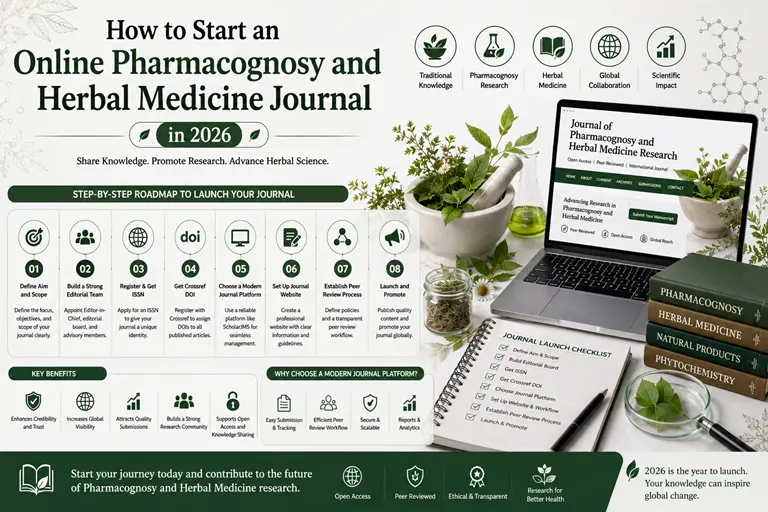
However, starting a successful journal requires far more than simply creating a website and inviting manuscript submissions. Modern scholarly publishing demands:
- Professional journal infrastructure
- Editorial and ethical policies
- Efficient manuscript management
- DOI implementation
- Indexing readiness
- Long-term sustainability
- International visibility
This comprehensive guide explains how to successfully launch an online pharmacognosy and herbal medicine journal in 2026.
Why Start a Pharmacognosy and Herbal Medicine Journal?
The field of pharmacognosy has evolved into a multidisciplinary scientific discipline that includes:
- Medicinal plant research
- Natural product chemistry
- Phytochemistry
- Ethnopharmacology
- Herbal drug standardization
- Pharmaceutical biotechnology
- Integrative medicine
- Drug discovery from natural sources
Leading pharmacognosy journals continue to attract substantial global readership and submissions because natural product research remains highly relevant to pharmaceutical innovation and public health.
A specialized journal can:
- Promote regional medicinal plant research
- Encourage international collaboration
- Publish interdisciplinary studies
- Increase institutional visibility
- Support emerging researchers
- Build a strong scholarly community
Step 1: Define the Journal's Scope and Vision
The first step is to establish a clear academic identity.
Define Your Aim
Your journal should have a well-defined mission, such as:
- Advancing pharmacognosy research
- Supporting evidence-based herbal medicine
- Promoting natural product drug discovery
- Publishing high-quality medicinal plant studies
Define Your Scope
Potential subject areas include:
- Pharmacognosy
- Phytochemistry
- Herbal drug technology
- Ethnopharmacology
- Natural product chemistry
- Herbal formulations
- Medicinal plant biotechnology
- Quality control and standardization
- Pharmacological studies
- Integrative medicine
Clearly defined aims and scope help attract the right authors and reviewers.
Step 2: Choose a Journal Name
Your journal title should be:
- Professional
- Memorable
- Easy to cite
- Specific to the discipline
- Internationally relevant
Avoid overly broad or misleading names.
The journal title should accurately represent its scientific focus and long-term vision.
Step 3: Establish the Editorial Structure
A strong editorial team is essential.
Your journal should appoint:
- Editor-in-Chief
- Associate Editors
- Section Editors
- Editorial Board Members
- International Advisors
Editorial board members should represent different countries and areas of expertise.
A strong editorial board significantly improves the credibility of a new journal.
Step 4: Develop Journal Policies
Every professional journal requires clear policies.
Editorial Policies
- Peer review policy
- Publication ethics
- Conflict of interest policy
- Plagiarism policy
- Retraction policy
Author Policies
- Author guidelines
- Submission instructions
- Copyright policy
- Open access policy
- Data availability policy
Clear policies improve trust and operational efficiency.
Step 5: Build a Professional Journal Website
A journal website is the public face of your publication.
The website should include:
- Home page
- About Journal
- Aims and Scope
- Editorial Board
- Current Issue
- Archives
- Author Guidelines
- Publication Ethics
- Contact Information
- Submission Portal
A professionally designed website significantly improves author confidence and indexing readiness.
Step 6: Implement a Manuscript Submission System
Manual manuscript handling through email is no longer sufficient.
Modern journals require:
- Online submissions
- Editorial tracking
- Reviewer management
- Automated notifications
- Publication workflows
Platforms such as ScholarJMS provide:
- Journal website development
- Manuscript submission systems
- Editorial workflow automation
- Reviewer management
- Article publishing workflows
- Reporting and analytics
Modern publishing infrastructure allows editors to focus on academic quality rather than administrative tasks.
Step 7: Apply for ISSN
An ISSN is one of the first formal requirements for a scholarly journal.
ISSNs help:
- Establish publishing identity
- Improve credibility
- Support indexing applications
- Facilitate metadata management
Many new journals require assistance with:
- Website readiness
- Editorial documentation
- ISSN application preparation
Professional services such as OJSCloud assist publishers with:
- ISSN consulting
- Journal launch support
- Website readiness assessment
- Publishing workflow implementation
Proper preparation significantly improves the likelihood of a successful ISSN application.
Step 8: Establish Crossref DOI Infrastructure
DOIs have become essential components of scholarly publishing.
Every article should have:
- Persistent identifiers
- Citation linking
- Reliable metadata
- Long-term discoverability
Crossref DOI implementation supports:
- Search engine visibility
- Citation tracking
- Scholarly communication
- International publishing standards
Services such as GetDOI assist journals with:
- Crossref onboarding
- DOI workflow implementation
- Metadata management
- DOI best practices
Early DOI planning prevents future operational challenges.
Step 9: Design a Robust Peer Review System
A high-quality peer review process is essential for academic credibility.
Many journals adopt:
- Double-blind peer review
- Single-blind peer review
- Open peer review
- Transparent peer review
Modern publishing increasingly emphasizes:
- Research integrity
- Editorial transparency
- Reviewer accountability
Platforms such as Scholar9 support transparent peer review initiatives and help strengthen trust in scholarly communication.
Step 10: Publish Your First Issue
The inaugural issue establishes the journal's reputation.
Editors should:
- Invite high-quality manuscripts
- Publish review articles
- Include contributions from established researchers
- Maintain rigorous peer review standards
The first issue should demonstrate the journal's academic quality and long-term vision.
Step 11: Prepare for Indexing
New journals often focus solely on publication and overlook indexing readiness.
Before applying to indexing services, journals should ensure:
- Publication consistency
- Metadata quality
- DOI implementation
- Editorial transparency
- Ethical policies
- High-quality content
Indexing readiness should be considered from the beginning of the journal's development.
Common Mistakes Made by New Journal Founders
Launching Without Clear Policies
Poor documentation can damage credibility.
Ignoring Technical Infrastructure
Manual workflows often become unsustainable.
Weak Editorial Boards
An ineffective editorial board may discourage quality submissions.
Delayed DOI Planning
Late implementation creates metadata problems.
Inadequate Website Development
Poor user experience can discourage authors and reviewers.
Lack of Long-Term Planning
Successful journals require strategic planning and sustainable management.
Estimated Infrastructure Required for a New Journal
A professional pharmacognosy journal generally requires:
- Journal website
- Submission system
- Editorial workflows
- ISSN
- DOI services
- Publication ethics documentation
- Long-term technical support
- Metadata management systems
Many institutions choose professional support to simplify these requirements.
CTA: Planning to Launch a New Pharmacognosy Journal?
We can help with:
- Journal website development
- ScholarJMS implementation
- ISSN consulting
- Crossref DOI support
- Editorial workflow setup
- OJS hosting and migration
- Journal launch consulting
- Publishing strategy development
WhatsApp: +91 82003 85143
WhatsApp Direct: https://wa.me/918200385143
Email: inquiry@ojscloud.com
Why Many New Journals Choose Integrated Publishing Solutions
Launching a scholarly journal involves numerous technical and administrative responsibilities.
Integrated publishing ecosystems simplify:
- Website management
- Submission workflows
- Editorial processes
- Metadata management
- DOI implementation
- Reporting and analytics
Professional support allows editorial teams to focus on:
- Research quality
- Author engagement
- Journal growth
- International visibility
CTA: Need Help Building Your Journal from Scratch?
Whether you are a university, scholarly society, research institute, or independent publisher, our team can assist you with the complete journal launch process.
Our services include:
- New journal website setup
- ScholarJMS implementation
- ISSN consulting
- Crossref DOI implementation
- OJS migration
- Editorial workflow configuration
- Publishing consultation
WhatsApp: +91 82003 85143
Email: inquiry@ojscloud.com
Frequently Asked Questions
How much does it cost to start an online journal?
Costs vary depending on website development, DOI services, hosting, and publishing infrastructure.
Can a university launch its own pharmacognosy journal?
Yes. Universities and research institutions frequently establish specialized journals to support scholarly communication.
Is ISSN mandatory?
An ISSN is not legally mandatory in every jurisdiction, but it is highly recommended because it improves credibility and supports indexing opportunities.
Should new journals implement DOI services immediately?
Yes. DOI implementation should be planned from the beginning of the journal's development.
Which manuscript management system is suitable for new journals?
Many new journals prefer integrated publishing solutions that simplify editorial workflows and reduce technical complexity.
Conclusion
The growing importance of medicinal plant research, natural product drug discovery, and evidence-based herbal medicine presents significant opportunities for launching specialized scholarly journals.
However, a successful journal requires much more than academic enthusiasm. It demands professional infrastructure, clear editorial policies, robust peer review systems, DOI implementation, and long-term publishing strategies.
By investing in proper journal development and adopting modern publishing technologies, new pharmacognosy and herbal medicine journals can establish themselves as credible, sustainable, and internationally visible platforms for scientific communication.
If you are planning to launch a new journal in pharmacognosy, herbal medicine, or natural product sciences, professional guidance can significantly simplify the process and help you build a strong foundation for long-term success.
Need expert assistance?
WhatsApp: +91 82003 85143
Email: inquiry@ojscloud.com