

Natural Products in Modern Drug Discovery: Scope for Pharmacy and Pharmacognosy Researchers
Natural Products in Modern Drug Discovery: Scope for Pharmacy and Pharmacognosy Researchers
Introduction
Nature has been one of humanity's greatest sources of medicines. From ancient herbal remedies to modern pharmaceutical products, natural products have played a central role in the prevention and treatment of diseases. Despite remarkable advances in synthetic chemistry, biotechnology, and computational drug design, natural products continue to provide unique chemical structures that inspire the development of new therapeutic agents.
In recent years, the pharmaceutical industry has witnessed renewed interest in medicinal plants, marine organisms, microorganisms, and naturally occurring bioactive compounds. The increasing burden of chronic diseases, antimicrobial resistance, and unmet medical needs has accelerated research into natural products as potential sources of novel drugs.
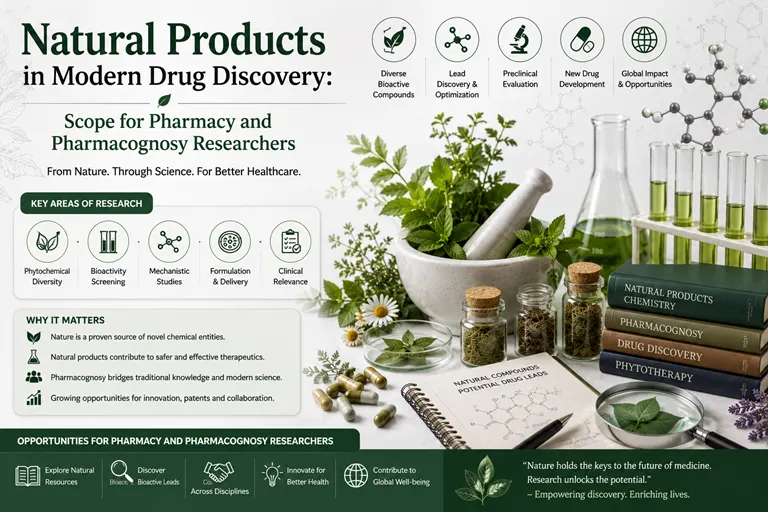
For pharmacy and pharmacognosy researchers, this resurgence represents an exciting opportunity to contribute to one of the most dynamic areas of pharmaceutical science.
The International Journal of Pharmacognosy and Herbal Drug Technology (IJPHDT) recognizes the importance of natural product research and encourages high-quality investigations that contribute to modern drug discovery and evidence-based herbal medicine.
Understanding Natural Products in Drug Discovery
Natural products are chemical compounds derived from:
- Medicinal plants
- Microorganisms
- Marine organisms
- Fungi
- Algae
- Animal-derived substances
These compounds often possess:
- Unique chemical structures
- Diverse biological activities
- Complex molecular architectures
- Multiple pharmacological targets
Unlike many synthetic compounds, natural products have evolved through biological processes and frequently exhibit high affinity toward specific biological systems.
This characteristic makes them invaluable resources in modern pharmaceutical research.
Historical Importance of Natural Products in Medicine
The history of medicine is closely linked to natural products.
Several important drugs originated from natural sources, including:
- Aspirin from willow bark derivatives
- Quinine from cinchona bark
- Morphine from opium poppy
- Paclitaxel from yew trees
- Artemisinin from traditional medicinal plants
These examples demonstrate the enormous potential of natural products to provide life-saving therapies.
Even today, a substantial proportion of approved drugs are either natural products or are inspired by naturally occurring compounds.
Why Natural Products Continue to Matter
Structural Diversity
Natural products possess complex molecular structures that are difficult to replicate through synthetic chemistry.
This diversity creates opportunities for discovering:
- New pharmacological targets
- Novel mechanisms of action
- Unique therapeutic agents
Biological Compatibility
Natural compounds often exhibit:
- Better target specificity
- Enhanced biological activity
- Lower toxicity profiles
- Improved therapeutic potential
Multi-Target Effects
Many natural products influence multiple biological pathways simultaneously, making them valuable for complex diseases.
Source of Lead Compounds
Natural products frequently serve as:
- Lead molecules
- Drug templates
- Pharmacological probes
- Starting materials for drug development
Major Sources of Natural Products for Drug Discovery
Medicinal Plants
Medicinal plants remain the largest source of natural products.
Research areas include:
- Phytochemical investigations
- Ethnopharmacological studies
- Herbal drug standardization
- Bioactivity screening
Medicinal plants continue to yield compounds with significant pharmaceutical potential.
Microbial Natural Products
Microorganisms have produced numerous therapeutic agents including:
- Antibiotics
- Anticancer agents
- Immunosuppressants
- Enzyme inhibitors
Microbial biotechnology remains a rapidly growing field of research.
Marine Natural Products
Marine organisms have emerged as valuable sources of:
- Anticancer compounds
- Antimicrobial agents
- Anti-inflammatory molecules
- Neuroprotective substances
Marine pharmacognosy is becoming increasingly important in pharmaceutical research.
Fungal Natural Products
Fungi produce a wide range of bioactive metabolites with applications in:
- Infectious diseases
- Cancer therapy
- Immunology
- Metabolic disorders
The Drug Discovery Process Using Natural Products
Natural product drug discovery generally involves several stages.
Selection of Biological Sources
Researchers select materials based on:
- Traditional knowledge
- Ethnobotanical evidence
- Biodiversity studies
- Random screening programs
Extraction and Isolation
Bioactive compounds are extracted using:
- Solvent extraction
- Fractionation techniques
- Chromatographic methods
Phytochemical Characterization
Analytical techniques include:
- HPLC
- GC-MS
- LC-MS
- NMR spectroscopy
- FTIR analysis
Biological Screening
Researchers evaluate:
- Antimicrobial activity
- Anticancer potential
- Anti-inflammatory effects
- Antioxidant activity
- Enzyme inhibition
Lead Optimization
Promising compounds undergo:
- Structural modification
- Pharmacological studies
- Toxicological investigations
- Preclinical evaluations
Therapeutic Areas Driving Natural Product Research
Cancer Research
Natural products continue to provide:
- Anticancer compounds
- Chemotherapeutic leads
- Targeted therapeutic agents
Infectious Diseases
The global threat of antimicrobial resistance has renewed interest in natural antimicrobials.
Diabetes and Metabolic Disorders
Medicinal plants offer promising opportunities for:
- Glycemic control
- Obesity management
- Metabolic regulation
Neurological Disorders
Natural compounds are increasingly investigated for:
- Alzheimer's disease
- Parkinson's disease
- Neuroprotection
- Cognitive enhancement
Cardiovascular Diseases
Research is focusing on:
- Cardioprotective phytochemicals
- Lipid-lowering agents
- Antihypertensive compounds
Emerging Technologies in Natural Product Drug Discovery
Artificial Intelligence and Machine Learning
Artificial intelligence is transforming natural product research through:
- Compound prediction
- Molecular docking
- Virtual screening
- Target identification
- Structure-activity relationship studies
AI can significantly reduce the time and cost of drug discovery.
Metabolomics
Metabolomics enables:
- Comprehensive chemical profiling
- Biomarker discovery
- Comparative phytochemical analysis
Genomics and Bioinformatics
Modern computational approaches facilitate:
- Gene cluster identification
- Biosynthetic pathway analysis
- Drug target prediction
Nanotechnology
Nanotechnology is helping improve:
- Drug delivery
- Bioavailability
- Therapeutic efficacy
- Target specificity
Challenges in Natural Product Drug Discovery
Despite significant opportunities, several challenges remain.
Complex Chemical Composition
Natural extracts often contain hundreds of compounds that complicate isolation and characterization.
Sustainable Resource Management
Overexploitation of medicinal resources threatens biodiversity.
Standardization Issues
Variability in natural materials affects reproducibility.
Regulatory Challenges
The transition from laboratory research to approved therapeutics requires extensive scientific evidence.
Long Development Timelines
Drug development remains expensive and time-consuming.
Research Opportunities for Pharmacy and Pharmacognosy Scholars in 2026
Natural product research is expected to remain one of the fastest-growing areas in pharmaceutical sciences.
Emerging research opportunities include:
- Natural product metabolomics
- AI-assisted drug discovery
- Marine pharmacognosy
- Medicinal plant biotechnology
- Herbal nanotechnology
- Bioactive compound standardization
- Multi-target therapeutic agents
- Sustainable medicinal plant utilization
- Ethnopharmacological validation
- Precision herbal medicine
Interdisciplinary collaboration will become increasingly important in these research areas.
Publication Opportunities in Natural Product Research
Research involving natural products is highly valued because it contributes to:
- Drug discovery
- Pharmaceutical innovation
- Public health advancement
- Evidence-based herbal medicine
- New therapeutic development
The International Journal of Pharmacognosy and Herbal Drug Technology (IJPHDT) welcomes manuscripts involving:
- Natural product chemistry
- Medicinal plant research
- Phytochemical investigations
- Drug discovery studies
- Herbal drug development
- Pharmacological evaluations
- Bioactive compound isolation
- Ethnopharmacological research
The journal provides an international platform for innovative studies that bridge traditional medicine and modern pharmaceutical sciences.
Digital Publishing and Research Visibility
Publishing high-quality research requires efficient dissemination and discoverability.
Modern journal publishing technologies support:
- Faster manuscript processing
- DOI integration
- Better metadata management
- Improved indexing readiness
- Enhanced author experience
Platforms such as ScholarJMS help journals streamline manuscript submission and editorial workflows, while GetDOI assists journals with Crossref DOI implementation and metadata management.
A Soft Note for Journal Editors and Publishers
The growing importance of natural product research has encouraged many institutions to establish specialized journals in pharmacognosy and herbal medicine.
Professional services such as OJSCloud support journals through:
- Journal website development
- ISSN consulting
- OJS hosting and migration
- Publishing workflow implementation
- Journal launch consulting
These services help journals establish professional publishing ecosystems and support sustainable scholarly communication.
Frequently Asked Questions
Why are natural products important in drug discovery?
Natural products possess unique chemical structures and biological activities that often lead to the discovery of new therapeutic agents.
Are medicinal plants still relevant in modern pharmaceutical research?
Yes. Medicinal plants remain one of the most important sources of bioactive compounds and drug leads.
What technologies are transforming natural product research?
Artificial intelligence, metabolomics, genomics, bioinformatics, and nanotechnology are significantly transforming natural product drug discovery.
What are the biggest challenges in natural product research?
Major challenges include standardization, sustainable utilization, complex chemistry, and lengthy drug development processes.
Where can researchers publish natural product research?
Researchers can publish their work in specialized journals such as the International Journal of Pharmacognosy and Herbal Drug Technology and other peer-reviewed journals focusing on natural products and pharmaceutical sciences.
Conclusion
Natural products continue to play an indispensable role in modern drug discovery and remain one of the most promising areas of pharmaceutical research. Advances in analytical chemistry, biotechnology, artificial intelligence, and computational sciences are creating unprecedented opportunities for pharmacy and pharmacognosy researchers.
As healthcare systems seek safer, more effective, and sustainable therapeutic solutions, natural products will remain central to the development of future medicines.
The International Journal of Pharmacognosy and Herbal Drug Technology (IJPHDT) remains committed to supporting innovative research that advances natural product science, medicinal plant research, and evidence-based drug discovery.
Researchers, academicians, and industry professionals are encouraged to contribute high-quality studies that shape the future of pharmacognosy and pharmaceutical sciences.