

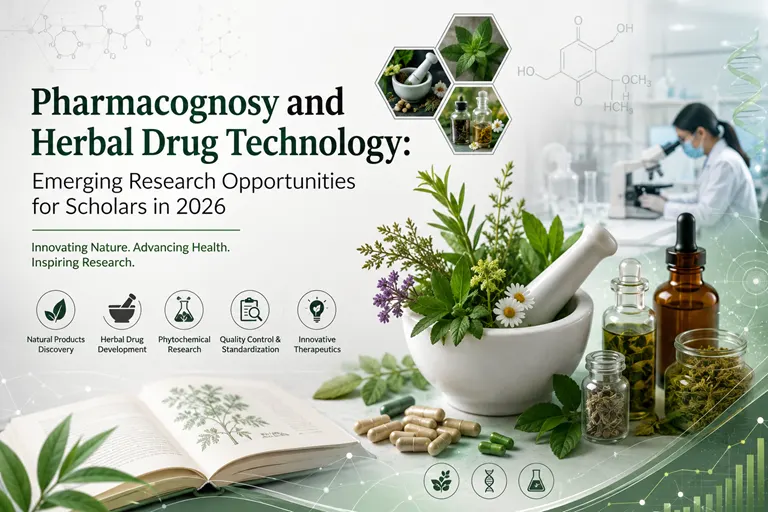
Pharmacognosy and Herbal Drug Technology: Emerging Research Opportunities for Scholars in 2026
Pharmacognosy and Herbal Drug Technology: Emerging Research Opportunities for Scholars in 2026
Introduction
The global healthcare landscape is witnessing renewed interest in medicinal plants, traditional medicines, and natural products as sources of safer and more sustainable therapeutic agents. Advances in analytical chemistry, biotechnology, artificial intelligence, and pharmaceutical sciences have significantly transformed the field of pharmacognosy and herbal drug technology.
In 2026, pharmacognosy is no longer confined to the identification of medicinal plants or the isolation of phytoconstituents. The discipline has evolved into a multidisciplinary research domain that integrates phytochemistry, molecular biology, pharmacology, nanotechnology, data science, and evidence-based medicine.
The International Journal of Pharmacognosy and Herbal Drug Technology (IJPHDT) recognizes the growing importance of this field and encourages researchers, academicians, industry professionals, and postgraduate scholars to explore innovative research directions that contribute to scientific understanding and public health advancement.
This article highlights emerging research opportunities, evolving methodologies, and publication trends that are shaping the future of pharmacognosy and herbal drug technology.
The Growing Global Importance of Pharmacognosy Research
Natural products continue to play a crucial role in modern drug discovery. Several important medicines currently used worldwide have originated from plants and other natural sources. Increasing concerns regarding antimicrobial resistance, chronic diseases, adverse drug reactions, and healthcare affordability have accelerated scientific interest in herbal medicines.
Several factors are driving the growth of pharmacognosy research:
- Increased demand for plant-based therapeutics
- Greater acceptance of traditional medicine systems
- Rising interest in complementary and integrative medicine
- Advances in analytical and molecular techniques
- Government initiatives supporting medicinal plant research
- Growing pharmaceutical and nutraceutical industries
These developments create substantial opportunities for researchers to contribute meaningful scientific evidence and innovative therapeutic solutions.
Emerging Research Areas in Pharmacognosy and Herbal Drug Technology
Phytochemical Profiling and Metabolomics
Modern phytochemical research has moved beyond preliminary screening methods. Advanced analytical technologies such as:
- LC-MS/MS
- GC-MS
- HPLC
- UPLC
- NMR spectroscopy
- Metabolomics platforms
allow researchers to identify bioactive compounds with remarkable precision.
Current research opportunities include:
- Identification of novel phytoconstituents
- Metabolomic fingerprinting of medicinal plants
- Comparative phytochemical studies
- Chemotaxonomic investigations
- Identification of biomarkers for quality control
Metabolomics is expected to become one of the most influential areas in herbal drug research over the next decade.
Herbal Drug Standardization and Quality Control
One of the biggest challenges in herbal medicine remains the lack of standardization and consistency in herbal formulations.
Research opportunities include:
- Development of pharmacopoeial standards
- Establishment of quality markers
- Authentication of medicinal plants
- Detection of adulteration
- Standardization of extraction methods
- Stability studies of herbal formulations
Quality control studies are highly valued because they directly improve the reliability and safety of herbal medicines.
Evidence-Based Herbal Medicine
The scientific validation of traditional knowledge is becoming increasingly important.
Researchers can contribute through:
- Preclinical pharmacological studies
- Clinical evaluations
- Safety assessments
- Toxicological investigations
- Systematic reviews
- Meta-analyses
The integration of traditional medicine with evidence-based healthcare is expected to remain a major research priority in 2026.
Medicinal Plant Biotechnology
Biotechnology is opening entirely new possibilities in pharmacognosy.
Emerging research areas include:
- Plant tissue culture
- Hairy root culture
- Genetic transformation
- Micropropagation
- Conservation biotechnology
- Secondary metabolite enhancement
Biotechnological interventions can improve both the yield and sustainability of medicinal plant resources.
Herbal Nanotechnology and Novel Drug Delivery Systems
Modern herbal medicines increasingly utilize advanced drug delivery technologies.
Research opportunities include:
- Herbal nanoparticles
- Phytosomes
- Liposomes
- Nanoemulsions
- Controlled-release systems
- Targeted herbal delivery systems
The combination of natural products and nanotechnology represents one of the fastest-growing areas in pharmaceutical research.
Artificial Intelligence and Data Science in Pharmacognosy
Artificial intelligence is beginning to transform natural product research.
Applications include:
- Drug target prediction
- Molecular docking studies
- Virtual screening
- Prediction of biological activity
- Data mining of traditional medicine knowledge
- AI-assisted phytochemical analysis
Machine learning tools can significantly accelerate the identification of promising therapeutic compounds and reduce the time required for drug discovery.
Researchers with interdisciplinary expertise in pharmacy and computational sciences are likely to become highly valuable contributors to future pharmacognosy research.
Pharmacognosy Research in Chronic Diseases
The global burden of chronic diseases continues to increase.
Research opportunities exist in:
- Diabetes management
- Obesity and metabolic disorders
- Cardiovascular diseases
- Cancer therapeutics
- Neurodegenerative disorders
- Inflammatory diseases
- Liver disorders
- Gastrointestinal diseases
Medicinal plants continue to provide promising therapeutic candidates for the management of these conditions.
Nutraceuticals and Functional Foods
The boundaries between food and medicine are becoming increasingly interconnected.
Emerging areas include:
- Functional food ingredients
- Herbal supplements
- Medicinal beverages
- Nutraceutical standardization
- Bioactive food compounds
- Preventive healthcare products
The nutraceutical industry is expected to create substantial research and commercial opportunities in the coming years.
Conservation of Medicinal Plants and Sustainable Utilization
Many medicinal plants face threats from habitat destruction and unsustainable harvesting.
Important research areas include:
- Conservation biology
- Sustainable harvesting practices
- Cultivation technologies
- Ethnobotanical documentation
- Biodiversity assessment
- Climate change impacts on medicinal plants
Sustainability has become an essential component of responsible pharmacognosy research.
Ethnopharmacology and Indigenous Knowledge Systems
Traditional knowledge systems remain invaluable sources of therapeutic innovation.
Emerging research opportunities include:
- Documentation of traditional remedies
- Validation of indigenous medicinal practices
- Community-based participatory research
- Preservation of ethnobotanical knowledge
- Digital repositories of traditional medicine
The scientific exploration of traditional medicine can contribute significantly to global healthcare.
Publication Opportunities for Pharmacognosy Researchers
Researchers in pharmacognosy and herbal drug technology have numerous publication opportunities.
High-impact manuscript categories include:
- Original research articles
- Review articles
- Short communications
- Systematic reviews
- Case studies
- Method development studies
- Standardization reports
- Clinical investigations
The International Journal of Pharmacognosy and Herbal Drug Technology (IJPHDT) provides a dedicated platform for publishing high-quality research that advances scientific understanding and practical applications in pharmacognosy and herbal medicine.
Researchers are encouraged to submit innovative studies that contribute to:
- Herbal drug development
- Natural product chemistry
- Medicinal plant biotechnology
- Evidence-based herbal medicine
- Pharmaceutical applications of natural products
Building Strong Research Projects in 2026
Successful pharmacognosy research increasingly requires multidisciplinary collaboration.
Researchers should consider integrating expertise from:
- Pharmacy
- Botany
- Biotechnology
- Chemistry
- Pharmacology
- Bioinformatics
- Clinical sciences
- Data science
Collaborative research projects are more likely to generate impactful findings and attract funding opportunities.
Digital Publishing and Research Visibility
Publishing quality research is only one aspect of scholarly communication. Ensuring discoverability, DOI integration, and efficient manuscript handling are becoming increasingly important for academic journals and researchers.
Modern journal publishing technologies now enable:
- Faster manuscript submission and peer review
- Better indexing readiness
- DOI integration and citation tracking
- Transparent editorial workflows
- Enhanced research visibility
Platforms such as ScholarJMS are helping journals modernize manuscript management and publication workflows, while services such as GetDOI assist journals with Crossref DOI implementation and metadata management. Initiatives promoting research transparency and trust continue to strengthen the integrity of scholarly publishing.
A Note for Editors and Emerging Journal Founders
As pharmacognosy research expands globally, there is growing demand for high-quality scholarly journals dedicated to medicinal plants, herbal medicine, and natural products.
Editors planning to launch new journals in this field should focus on:
- Robust editorial policies
- Double-blind peer review
- DOI readiness
- ISSN compliance
- Ethical publishing standards
- Efficient manuscript management systems
Organizations such as OJSCloud provide consulting and technical guidance for journals seeking support with journal website development, ISSN readiness, OJS migration, and publishing workflow implementation.
Frequently Asked Questions
What are the most promising research areas in pharmacognosy in 2026?
Phytochemical profiling, herbal nanotechnology, AI-driven drug discovery, medicinal plant biotechnology, and evidence-based herbal medicine are among the most promising areas.
Is pharmacognosy still relevant in modern pharmaceutical research?
Yes. Natural products continue to provide important therapeutic molecules and remain a major source of new drug candidates.
Can interdisciplinary research improve publication opportunities?
Absolutely. Collaborative studies involving pharmacy, biotechnology, chemistry, and computational sciences often generate highly impactful research findings.
Why is herbal drug standardization important?
Standardization improves safety, efficacy, quality, and reproducibility of herbal medicines and supports their integration into modern healthcare.
Where can researchers publish pharmacognosy and herbal medicine research?
Researchers can publish their findings in specialized journals such as the International Journal of Pharmacognosy and Herbal Drug Technology and other peer-reviewed journals focusing on medicinal plant sciences and pharmaceutical research.
Conclusion
The field of pharmacognosy and herbal drug technology is entering an exciting era of scientific innovation. Advances in biotechnology, artificial intelligence, analytical chemistry, and evidence-based medicine are opening entirely new research opportunities for scholars worldwide.
The future of pharmacognosy lies in interdisciplinary collaboration, scientific validation of traditional knowledge, sustainable utilization of medicinal resources, and the development of innovative natural product-based therapeutics.
The International Journal of Pharmacognosy and Herbal Drug Technology (IJPHDT) remains committed to supporting high-quality research that advances the understanding and application of medicinal plants and herbal drug technologies. Researchers, academicians, and industry professionals are encouraged to contribute their findings and participate in shaping the future of this rapidly evolving scientific discipline.