

Phytochemical Profiling of Medicinal Plants: Methods, Applications, and Publication Opportunities
Phytochemical Profiling of Medicinal Plants: Methods, Applications, and Publication Opportunities
Introduction
Medicinal plants have been used for centuries as valuable sources of therapeutic agents. Despite the tremendous advances in synthetic chemistry and biotechnology, natural products continue to provide important bioactive compounds that contribute to modern medicine, pharmaceutical development, nutraceuticals, and healthcare innovations.
The scientific investigation of medicinal plants has become increasingly sophisticated. Today, researchers are expected not only to identify medicinal species but also to characterize their chemical composition, evaluate biological activities, and establish quality standards. This has made phytochemical profiling one of the most important areas of research in pharmacognosy and herbal drug technology.
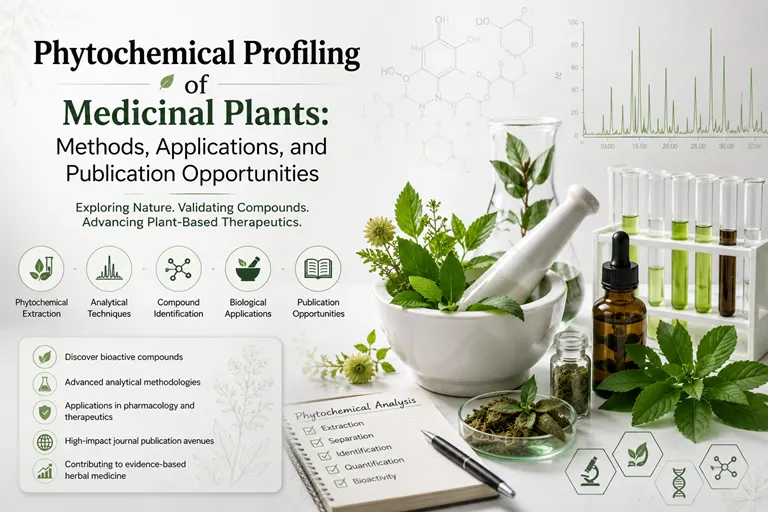
Phytochemical profiling involves the systematic identification, characterization, and quantification of chemical constituents present in medicinal plants. These studies provide the foundation for herbal drug standardization, pharmacological investigations, quality control, and natural product drug discovery.
The International Journal of Pharmacognosy and Herbal Drug Technology (IJPHDT) encourages high-quality research in phytochemistry and medicinal plant sciences, recognizing their critical role in the advancement of evidence-based herbal medicine and pharmaceutical sciences.
Understanding Phytochemical Profiling
Phytochemical profiling refers to the comprehensive study of secondary metabolites and bioactive compounds present in medicinal plants.
These compounds include:
- Alkaloids
- Flavonoids
- Terpenoids
- Tannins
- Glycosides
- Saponins
- Phenolic compounds
- Steroids
- Coumarins
- Essential oils
The identification and characterization of these compounds help researchers understand:
- Therapeutic potential
- Mechanisms of action
- Toxicological properties
- Drug development possibilities
- Quality control parameters
- Chemotaxonomic relationships
Modern phytochemical profiling integrates traditional pharmacognosy with advanced analytical technologies, making it an interdisciplinary and highly dynamic research field.
Why Phytochemical Profiling Matters
Scientific Validation of Traditional Medicine
Traditional medicinal systems possess extensive knowledge regarding the therapeutic use of plants. Phytochemical profiling helps scientifically validate these practices by identifying the compounds responsible for biological activities.
Discovery of New Therapeutic Agents
Numerous modern drugs have originated from plant-derived compounds. Phytochemical investigations continue to identify new molecules with potential pharmaceutical applications.
Herbal Drug Standardization
Variability in herbal medicines remains a major challenge. Chemical profiling helps establish quality markers and improves consistency and reproducibility.
Safety Assessment
Some medicinal plants contain toxic compounds. Phytochemical studies contribute significantly to the safety evaluation of herbal medicines.
Intellectual Property and Product Development
Detailed chemical characterization often supports the development of novel herbal products, nutraceuticals, and patented formulations.
Major Classes of Phytochemicals in Medicinal Plants
Alkaloids
Alkaloids are nitrogen-containing compounds with diverse pharmacological activities.
Examples include:
- Analgesic agents
- Antimalarial compounds
- Anticancer molecules
- Antimicrobial agents
Flavonoids
Flavonoids are among the most extensively studied phytochemicals due to their:
- Antioxidant activity
- Anti-inflammatory properties
- Cardioprotective effects
- Neuroprotective potential
Terpenoids
Terpenoids contribute significantly to:
- Essential oils
- Antimicrobial activities
- Anticancer research
- Drug discovery programs
Phenolic Compounds
Phenolics have attracted considerable attention because of their:
- Antioxidant properties
- Anti-aging effects
- Disease prevention potential
Glycosides and Saponins
These compounds exhibit:
- Anti-inflammatory activities
- Immunomodulatory properties
- Cardiovascular benefits
- Antimicrobial effects
Traditional Methods of Phytochemical Screening
Organoleptic Evaluation
This includes:
- Colour
- Odour
- Taste
- Texture
- Morphological characteristics
Although simple, organoleptic analysis remains an important preliminary identification method.
Microscopic Evaluation
Microscopy assists in:
- Plant authentication
- Identification of adulterants
- Detection of diagnostic features
Preliminary Phytochemical Tests
Chemical tests are performed to identify various classes of compounds, including:
- Alkaloid tests
- Flavonoid tests
- Tannin tests
- Saponin tests
- Steroid tests
These methods remain valuable screening tools in pharmacognosy laboratories.
Advanced Analytical Methods for Phytochemical Profiling
High Performance Liquid Chromatography (HPLC)
HPLC is widely used for:
- Quantitative analysis
- Standardization studies
- Fingerprinting of herbal drugs
- Identification of marker compounds
Gas Chromatography Mass Spectrometry (GC-MS)
GC-MS is particularly useful for:
- Essential oil analysis
- Volatile compound characterization
- Metabolite identification
Liquid Chromatography Mass Spectrometry (LC-MS)
LC-MS offers exceptional sensitivity and allows:
- Identification of unknown compounds
- Metabolomic studies
- Structural elucidation
Ultra Performance Liquid Chromatography (UPLC)
UPLC provides:
- Faster analysis
- Higher resolution
- Better sensitivity
- Reduced solvent consumption
Nuclear Magnetic Resonance (NMR) Spectroscopy
NMR is considered one of the most powerful techniques for:
- Structural characterization
- Compound identification
- Purity assessment
Fourier Transform Infrared Spectroscopy (FTIR)
FTIR is useful for:
- Functional group identification
- Herbal drug authentication
- Comparative studies
Metabolomics and Modern Phytochemistry
Metabolomics has revolutionized medicinal plant research.
The approach involves:
- Comprehensive metabolite profiling
- Biomarker discovery
- Comparative plant studies
- Systems biology investigations
Metabolomics provides deeper insights into plant chemistry and is increasingly becoming an essential component of advanced pharmacognosy research.
Applications of Phytochemical Profiling
Herbal Drug Standardization
Phytochemical fingerprinting helps establish:
- Quality specifications
- Marker compounds
- Batch consistency
- Regulatory compliance
Drug Discovery and Development
Many natural compounds serve as:
- Lead molecules
- Drug candidates
- Pharmacological templates
Nutraceutical Development
Plant-derived compounds are increasingly used in:
- Functional foods
- Dietary supplements
- Preventive healthcare products
Quality Control of Herbal Medicines
Chemical profiling enables:
- Detection of adulteration
- Authentication of medicinal plants
- Standardization of herbal formulations
Chemotaxonomy
Phytochemical patterns often assist in:
- Plant classification
- Species differentiation
- Evolutionary studies
Emerging Research Trends in 2026
Artificial Intelligence in Phytochemical Research
Artificial intelligence is increasingly being used for:
- Compound prediction
- Molecular docking
- Data mining
- Drug-target interaction studies
Green Extraction Technologies
Researchers are adopting sustainable extraction methods such as:
- Microwave-assisted extraction
- Ultrasound-assisted extraction
- Supercritical fluid extraction
Nanotechnology and Herbal Medicines
Nanotechnology is creating new possibilities for:
- Improved bioavailability
- Targeted drug delivery
- Enhanced therapeutic efficacy
Integrated Omics Approaches
Combining:
- Genomics
- Transcriptomics
- Proteomics
- Metabolomics
is opening new directions in medicinal plant research.
Challenges in Phytochemical Profiling
Despite significant progress, several challenges remain:
- Variability in plant materials
- Environmental influences
- Lack of standardization
- Complex chemical compositions
- Limited reference standards
- Reproducibility issues
Addressing these challenges remains a major priority for researchers and pharmaceutical industries.
Writing and Publishing Phytochemical Research Papers
High-quality phytochemical research requires careful scientific documentation.
A strong manuscript generally includes:
Introduction
- Research rationale
- Literature review
- Study objectives
Materials and Methods
- Plant authentication
- Extraction procedures
- Analytical methodologies
- Statistical analysis
Results
- Chemical findings
- Chromatograms
- Spectral analysis
- Quantitative data
Discussion
- Interpretation of findings
- Comparison with previous studies
- Scientific significance
Conclusion
- Major findings
- Applications
- Future research directions
Publication Opportunities in Phytochemistry and Pharmacognosy
Research involving medicinal plants and phytochemical profiling is increasingly sought after by scholarly journals due to its relevance to:
- Drug discovery
- Herbal medicine development
- Pharmaceutical sciences
- Nutraceutical innovation
- Public health
The International Journal of Pharmacognosy and Herbal Drug Technology (IJPHDT) welcomes high-quality submissions in areas including:
- Phytochemical investigations
- Herbal drug standardization
- Medicinal plant biotechnology
- Pharmacological evaluation
- Natural product chemistry
- Herbal formulation research
- Metabolomics studies
- Evidence-based herbal medicine
The journal aims to provide an international platform for researchers working at the intersection of pharmacognosy, phytochemistry, and herbal drug technology.
Improving Research Visibility Through Modern Publishing Technologies
Publishing impactful research also requires efficient dissemination and discoverability.
Modern scholarly publishing platforms facilitate:
- Faster manuscript processing
- Better metadata management
- DOI integration
- Enhanced indexing readiness
- Improved author experience
Solutions such as ScholarJMS support journals through integrated manuscript management and publishing workflows, while GetDOI assists journals in implementing efficient Crossref DOI processes and metadata management systems.
A Soft Note for Journal Editors and Publishers
As medicinal plant research continues to grow globally, many institutions and societies are considering launching new journals in pharmacognosy and herbal medicine.
Professional services such as OJSCloud provide support for:
- Journal website development
- ISSN consulting
- Publishing workflow implementation
- OJS hosting and migration
- Journal launch consulting
These services help emerging journals establish professional publishing infrastructures that meet modern scholarly communication standards.
Frequently Asked Questions
What is phytochemical profiling?
Phytochemical profiling is the systematic identification and characterization of chemical compounds present in medicinal plants.
Which analytical technique is most widely used in phytochemical studies?
High Performance Liquid Chromatography (HPLC) is among the most widely used techniques for phytochemical analysis and standardization.
Why is phytochemical profiling important in herbal medicine?
It supports quality control, drug discovery, standardization, and scientific validation of traditional medicinal plants.
Can phytochemical studies lead to new drug discoveries?
Yes. Numerous modern medicines have originated from plant-derived compounds identified through phytochemical investigations.
Where can researchers publish phytochemical studies?
Researchers can publish their findings in peer-reviewed journals such as the International Journal of Pharmacognosy and Herbal Drug Technology and other journals specializing in pharmacognosy and medicinal plant sciences.
Conclusion
Phytochemical profiling remains one of the most important and rapidly evolving areas in pharmacognosy and herbal drug technology. Advances in analytical chemistry, metabolomics, artificial intelligence, and natural product research are creating unprecedented opportunities for scholars worldwide.
By integrating traditional knowledge with modern scientific methodologies, researchers can contribute significantly to herbal medicine standardization, drug discovery, and evidence-based healthcare.
The International Journal of Pharmacognosy and Herbal Drug Technology (IJPHDT) remains committed to promoting high-quality research in medicinal plants, phytochemistry, and natural product sciences and welcomes innovative contributions that advance the field of pharmacognosy and herbal drug technology.